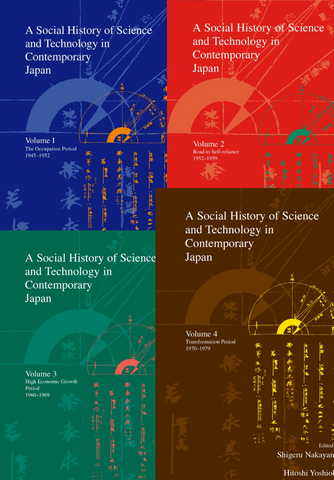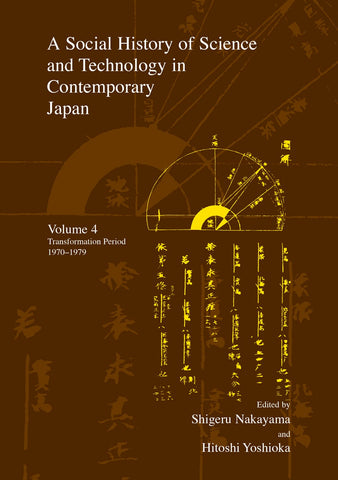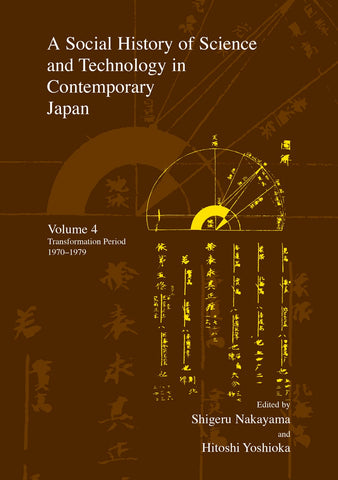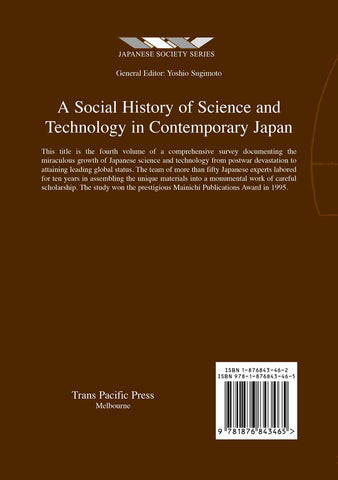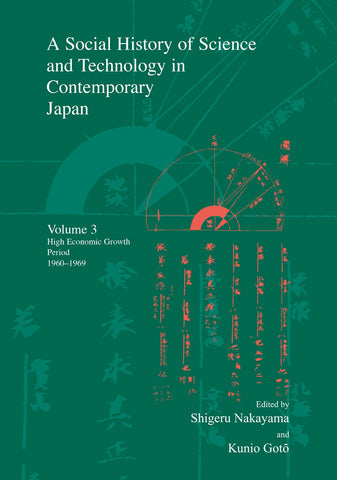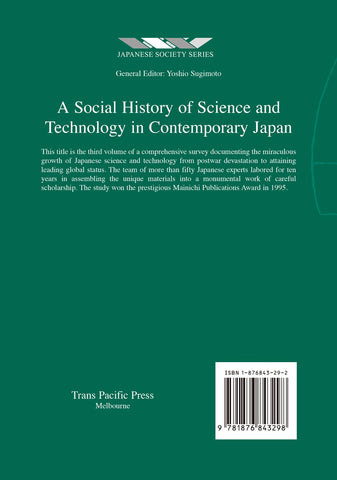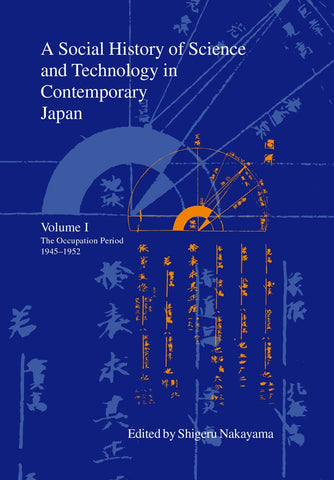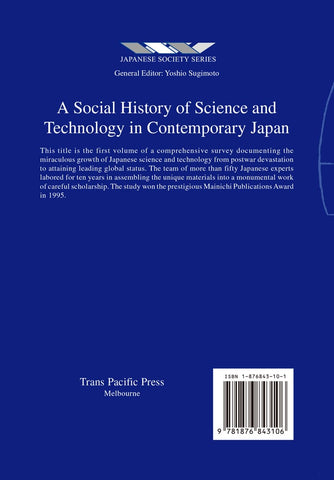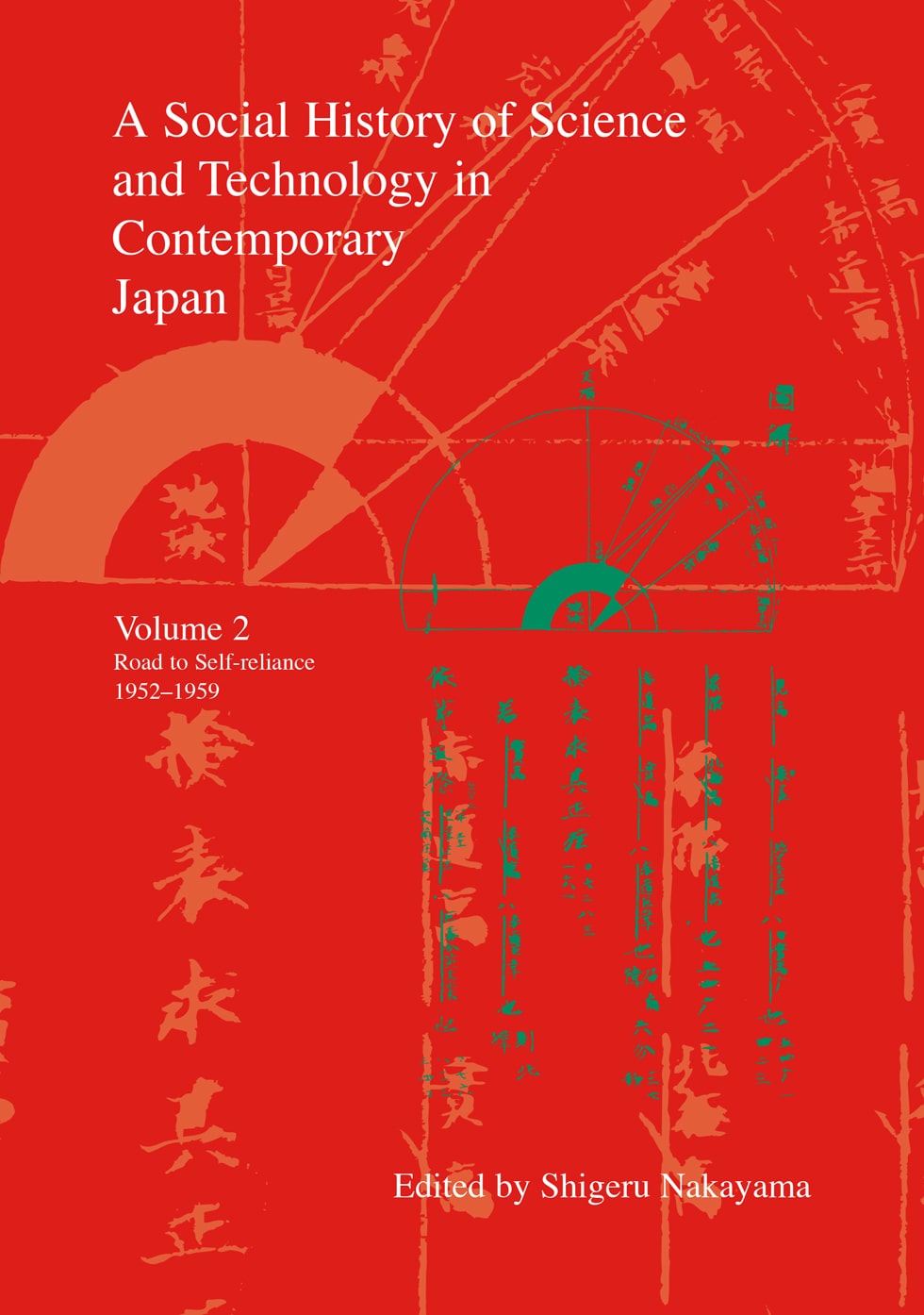
Social History of Science and Technology Vol.2
Many In Stock
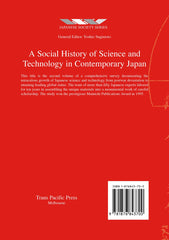
Volume 2 of the four-volume A Social History of Science and Technology in Contemporary Japan examines the critical years from 1952 to 1959, when Japan sought to rebuild its scientific and technological capabilities following the end of the Allied Occupation. It explores how government, universities, industry, and the scientific community worked together to establish a new national system of research and innovation, laying the foundations for the country's rapid economic growth.
The volume examines the revival of nuclear, aviation, and space research; the development of government and corporate R&D systems; the modernization of key industries, including steel, shipbuilding, automobiles, electronics, and pharmaceuticals; and the ways technological innovation transformed everyday life. Written by more than fifty leading Japanese historians of science and technology, this English edition makes a landmark work of Japanese scholarship available to an international audience for the first time. It is an essential resource for researchers and students of the history of science, Science and Technology Studies (STS), Japanese Studies, and postwar East Asian history.
Awards
Mainichi Publications Award (1997)
About Editors and Authors
NAKAYAMA Shigeru was a leading Japanese scholar specializing in the history of science. He was Professor Emeritus at Kanagawa University and Vice-Chairman of the International Academy of the History of Science. In 1945, he joined the Hiroshima High School Science Class (now Hiroshima University), and was exposed to the atomic bomb at his residence. In 1948, he moved to Tokyo to join the Department of Astronomy, Faculty of Science, University of Tokyo, and upon graduating in 1951 was employed by the publisher Heibonsha. In 1955, he joined the Graduate School of Harvard University as a Fulbright Scholar and was awarded a PhD in 1960. After returning to Japan, he served in the Faculty of Arts and Sciences of the University of Tokyo as Lecturer, and later went on to become Assistant Professor. He retired from the University of Tokyo in 1989 and became Professor at Kanagawa University. His career produced a wide range of research achievements, including in the history of science and technology in China and Japan, the history of universities and the social history of science. He passed away in 2014.
Table of contents
Introduction: The Road to High Economic Growth, Shigeru Nakayama
Part I: End of Prohibitions on Research into Nuclear, Aviation and Military Technology
1 Lifting the Bans on Weapons Production and Rebuilding the Aircraft Industry, Hitoshi Yoshioka
2 Re-establishing Civil Aviation, Hitoshi Yoshioka
3 Forming a Nuclear Regime and Introducing Commercial Reactors, Hitoshi Yoshioka
4 Nuclear Power Research and the Scientists’ Role, Hitoshi Yoshioka
5 The Bikini Incident and Radiation Surveys, Yukuo Sasamoto
6 Advances in Space Research, Hitoshi Yoshioka
7 The Beginning of Organized Science Reporting, Yukio Wakamatsu
Part II: Establishment of a Government and Business-Centered R&D System
8 Establishing a Science and Technology Administrative System, Hiroaki Tanaka
9 Strengthening Government Research Institutes, Shūichi Tsukahara
10 Importing Technology, Katsuhiro Arai
11 Foreign Technology Transfers and Corporate R&D, Tetsurō Nakaoka
12 Developments in Corporate Engineering and Technical Training, Katsuhiro Arai
Part III: New Attitudes among Scientists and Engineers
13 Overseas Study Leave and Participation in International Conferences, Shigeru Nakayama
14 The First Japanese Antarctic Research Expedition, Toshifumi Yatsumimi
15 Postwar Reforms to Higher Education: The New Graduate School Standard, Takashi Hata
16 The Development of Molecular Biology in Japan, Masayuki Ōbayashi
17 The Scientist Led Peace Movement, Shigeru Nakayama
18 Technology Studies, Technological Innovation and State Monopoly Capitalism, Kunio Goto
Part IV: Development of Key Industries and the Modernization of Manufacutring
19 Heavy and Chemical Industries and Coastal Industrial Zones, Toru Takamatsu
20 The Energy Revolution and Changing Energy Policies, Kunio Gotō
21 The Energy Revolution, Munehiro Miwa
22 The Reconstruction of the Electric Power Industry, Takuji Okamoto
23 The ‘Spin-off’ from the Navy: The Case of Shipbuilding and Marine Engineering in the Postwar Period, Miwao Matsumoto
24 Rationalization and Technical Innovation in the Steel Industry, Mitsuru Tate
25 Railway Electrifi cation, Tōru Koyama
26 Agriculture Develops a Pesticide-Dependency, Takako Ieda
27 The Mechanization of Rice Cultivation, Hisashi Horio
28 Penicillin Production and the Reconstruction of the Pharmaceutical Industry, Hazime Mizoguchi
Part V: Changing Lifestyles through Science and Technology
29 A New Start for the Automotive Industry, Tsutomu Demizu
30 The Rise of the Motorcycle Industry, Tsutomu Demizu
31 Evolution in the Precision Machinery Industries: From Domestic Use to Export, Shūichi Tsukahara
32 The Diffusion of Household Electrical Appliances, Yayoi Yoshioka
33 The Advent of the Television Age, Hitoshi Yoshioka
34 The Development of Transistor Technology, Hitoshi Yoshioka
35 The Introduction of American Style Food Culture, Yayoi Yoshioka
36 The First Innovations in Medical Technology after WWII, Shigenobu Kambayashi
Consolidated Bibliography
Related Books
-
A Social History of Science and Technology in Contemporary Japan (Complete Set)Order all four-books together for "A Social His...Order all four-books together for "A Social History of Science and Technology in Contemporary Japan" which documents the miraculous growth of Japanese science and technology from post-war devastati...
-
![Award Winning Book]()
![A History of Modern Chemistry]() A History of Modern ChemistryNoboru Hirota has produced a major historical a...Noboru Hirota has produced a major historical analysis of how the field of chemistry has evolved over centuries. Spanning more than eight hundred pages, this book presents an exhaustive study of th...
A History of Modern ChemistryNoboru Hirota has produced a major historical a...Noboru Hirota has produced a major historical analysis of how the field of chemistry has evolved over centuries. Spanning more than eight hundred pages, this book presents an exhaustive study of th... -
![Award Winning Book]()
![Social History of Science and Technology Vol.4]()
![Social History of Science and Technology Vol.4]() Social History of Science and Technology Vol.4Volume 4 of the four-volume A Social History of...Volume 4 of the four-volume A Social History of Science and Technology in Contemporary Japan examines the transformative decade of the 1970s, when Japan confronted the social and environmental cons...
Social History of Science and Technology Vol.4Volume 4 of the four-volume A Social History of...Volume 4 of the four-volume A Social History of Science and Technology in Contemporary Japan examines the transformative decade of the 1970s, when Japan confronted the social and environmental cons... -
![Award Winning Book]()
![Social History of Science and Technology Vol.3]()
![Social History of Science and Technology Vol.3]() Social History of Science and Technology Vol.3Volume 3 of the four-volume A Social History of...Volume 3 of the four-volume A Social History of Science and Technology in Contemporary Japan examines the period of high economic growth, when Japan emerged as one of the world's leading scientific...
Social History of Science and Technology Vol.3Volume 3 of the four-volume A Social History of...Volume 3 of the four-volume A Social History of Science and Technology in Contemporary Japan examines the period of high economic growth, when Japan emerged as one of the world's leading scientific... -
![Award Winning Book]()
![Social History of Science and Technology Vol.1]()
![Social History of Science and Technology Vol.1]() Social History of Science and Technology Vol.1Volume 1 of the four-volume A Social History of...Volume 1 of the four-volume A Social History of Science and Technology in Contemporary Japan examines the occupation years from 1945 to 1952, when Japan's scientific and technological institutions ...
Social History of Science and Technology Vol.1Volume 1 of the four-volume A Social History of...Volume 1 of the four-volume A Social History of Science and Technology in Contemporary Japan examines the occupation years from 1945 to 1952, when Japan's scientific and technological institutions ...