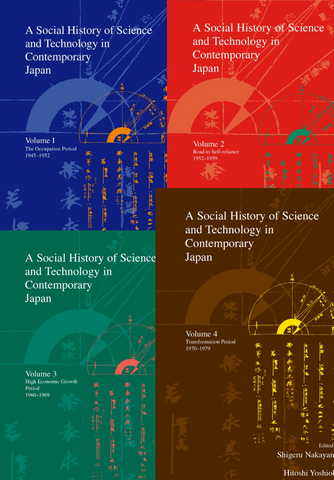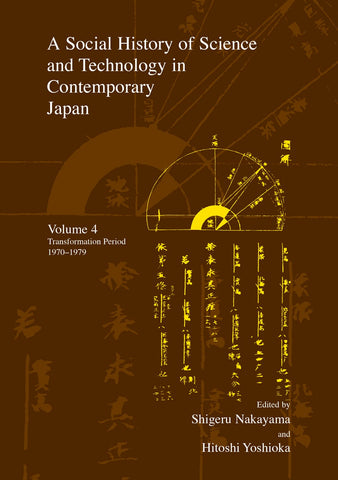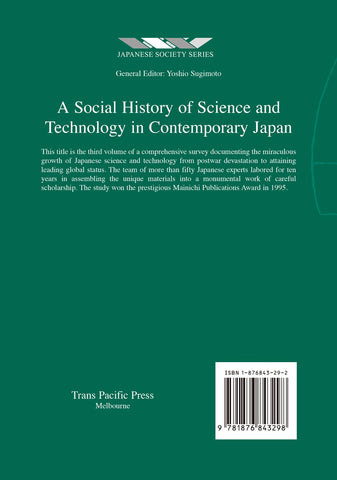

Social History of Science and Technology Vol.4
Many In Stock
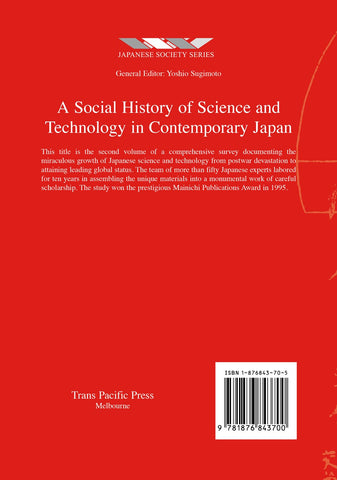
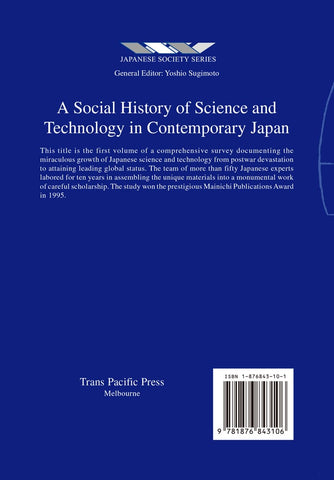
Volume 4 of the four-volume A Social History of Science and Technology in Contemporary Japan examines the transformative decade of the 1970s, when Japan confronted the social and environmental consequences of rapid economic growth while entering the age of high technology. It explores how government, industry, researchers, and citizens responded to new challenges including pollution, energy security, environmental protection, and the changing role of science and technology in society.
The volume covers the oil crisis and energy conservation policies, nuclear power and alternative energy, science and technology policy, research funding, and the emergence of knowledge-intensive industries such as semiconductors, software, automation, and life sciences. It also examines the growing influence of environmental movements, public debate, and technological innovation in shaping modern Japan. Written by more than fifty leading Japanese historians of science and technology, this English edition makes a landmark work of Japanese scholarship available to an international audience for the first time. It is an essential resource for researchers and students of the history of science, Science and Technology Studies (STS), Japanese Studies, economic history, environmental history, and postwar East Asian history.
Reviews
"An indispensable resource...Highly recommended. Upper-division undergraduates through professionals; two-year technical program students." - CHOICE on Volume 1
About Editors and Authors
NAKAYAMA Shigeru
NAKAYAMA Shigeru was a leading Japanese scholar specializing in the history of science. He was Professor Emeritus at Kanagawa University and Vice-Chairman of the International Academy of the History of Science. In 1945, he joined the Hiroshima High School Science Class (now Hiroshima University), and was exposed to the atomic bomb at his residence. In 1948, he moved to Tokyo to join the Department of Astronomy, Faculty of Science, University of Tokyo, and upon graduating in 1951 was employed by the publisher Heibonsha. In 1955, he joined the Graduate School of Harvard University as a Fulbright Scholar and was awarded a PhD in 1960. After returning to Japan, he served in the Faculty of Arts and Sciences of the University of Tokyo as Lecturer, and later went on to become Assistant Professor. He retired from the University of Tokyo in 1989 and became Professor at Kanagawa University. His career produced a wide range of research achievements, including in the history of science and technology in China and Japan, the history of universities and the social history of science. He passed away in 2014.
YOSHIOKA Hitoshi
YOSHIOKA Hitoshi is Former Professor in the Graduate School of Social and Cultural Studies Research, Kyushu University. He specializes in the history of science and technology.
He graduated from the Department of Physics, Faculty of Science, University of Tokyo, in 1976, and went on to become Lecturer, and later Associate Professor, in the Faculty of Economics, Wakayama University. He previously served as Assistant Professor in the Faculty of Liberal Arts, Kyushu University, before taking up Professorship in 1994. Since the 1990s, his primary research interest has been the history of nuclear policy. He passed away in 2018.
Table of contents
Introduction: The Transformation Period 1970–1979, Hitoshi Yoshioka
Part I: Pollution, Environment and Safety Problems
1 Pollution and Environmental Protection, Zenji Suzuki
2 The Development of Anti-Pollution Technology, Tsutomu Demizu
3 Defective Cars and Product Liability, Sanae Hara
4 Environmental Issues and Citizens’ Movements, Kiyoshi Toda
5 Environmental Journalism in the 1970s, Yukio Wakamatsu
6 The Industrialization of Agriculture, Animal Husbandry, Forestry and Fishery, Kiyoshi Toda and Kōyū Furusawa
Part II: Energy and Resource Problems
7 The Oil Crisis and Energy Saving Policies, Kunio Gotō
8 Reorganization of the Administration and Regulation of Nuclear Development, Hitoshi Yoshioka
9 Nuclear Power Plant Location Disputes, Hitoshi Yoshioka
10 The Development of Nuclear Fuel-Cycle Technology, Hitoshi Yoshioka
11 The Development of Nuclear Fusion Research, Hitoshi Yoshioka
12 The Social Background of Alternative Energy Development, Miwao Matsumoto
Part III: Diversified Development ofScience and Technology Policies
13 Scientific and Technological Cooperation with Developing Countries, Shigeru Nakayama
14 The Second and Third National Development Plans, Kunio Gotō
15 The Development of Think Tanks and Their Contribution to Policy Formulation, Katsuhiro Arai
16 Funding Big Academic Projects, Shigeru Nakayama
17 Private Funding for Scientific Research, Yoshinori Yamaoka
18 The Training of Science and Technology Specialists, Katsuhiro Arai
19 ‘Over Doctors’ and the Market for Researchers, Nobuki Nakayama
20 Problems with the Compulsory Health Insurance System, Saburō Nishi
Part IV: The Rise of Knowledge-intensiveand High Technology Industries
21 Towards a Knowledge-intensive Industrial Structure, Shūichi Tsukahara
22 The National Promotion of ‘Life Science’, Hikaru Saitoh
23 Military Aircraft and Domestic Technology, Hitoshi Yoshioka
24 Liberalization of the Computer Market, Hideto Nakajima
25 Japan’s Semiconductor Industry, Hideto Nakajima
26 Growth of the Software Industry, Kotarō Nakazu
27 Automation of the Manufacturing Industry, Tsutomu Demizu
28 High-tech Medicine, Shirō Sakaguchi
Consolidated Bibliography
Index
Related Books
-
A Social History of Science and Technology in Contemporary Japan (Complete Set)Order all four-books together for "A Social His...Order all four-books together for "A Social History of Science and Technology in Contemporary Japan" which documents the miraculous growth of Japanese science and technology from post-war devastati...
-
![Award Winning Book]()
![A History of Modern Chemistry]() A History of Modern ChemistryNoboru Hirota has produced a major historical a...Noboru Hirota has produced a major historical analysis of how the field of chemistry has evolved over centuries. Spanning more than eight hundred pages, this book presents an exhaustive study of th...
A History of Modern ChemistryNoboru Hirota has produced a major historical a...Noboru Hirota has produced a major historical analysis of how the field of chemistry has evolved over centuries. Spanning more than eight hundred pages, this book presents an exhaustive study of th... -
![Award Winning Book]()
![Social History of Science and Technology Vol.3]()
![Social History of Science and Technology Vol.3]() Social History of Science and Technology Vol.3Volume 3 of the four-volume A Social History of...Volume 3 of the four-volume A Social History of Science and Technology in Contemporary Japan examines the period of high economic growth, when Japan emerged as one of the world's leading scientific...
Social History of Science and Technology Vol.3Volume 3 of the four-volume A Social History of...Volume 3 of the four-volume A Social History of Science and Technology in Contemporary Japan examines the period of high economic growth, when Japan emerged as one of the world's leading scientific... -
![Award Winning Book]()
![Social History of Science and Technology Vol.2]()
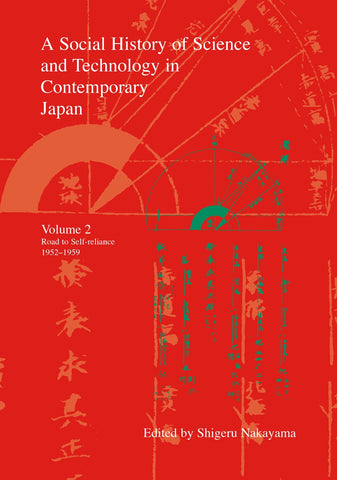
![Social History of Science and Technology Vol.2]() Social History of Science and Technology Vol.2Volume 2 of the four-volume A Social History of...Volume 2 of the four-volume A Social History of Science and Technology in Contemporary Japan examines the critical years from 1952 to 1959, when Japan sought to rebuild its scientific and technolog...
Social History of Science and Technology Vol.2Volume 2 of the four-volume A Social History of...Volume 2 of the four-volume A Social History of Science and Technology in Contemporary Japan examines the critical years from 1952 to 1959, when Japan sought to rebuild its scientific and technolog... -
![Award Winning Book]()
![Social History of Science and Technology Vol.1]()
![Social History of Science and Technology Vol.1]() Social History of Science and Technology Vol.1Volume 1 of the four-volume A Social History of...Volume 1 of the four-volume A Social History of Science and Technology in Contemporary Japan examines the occupation years from 1945 to 1952, when Japan's scientific and technological institutions ...
Social History of Science and Technology Vol.1Volume 1 of the four-volume A Social History of...Volume 1 of the four-volume A Social History of Science and Technology in Contemporary Japan examines the occupation years from 1945 to 1952, when Japan's scientific and technological institutions ...